
You’ve heard it
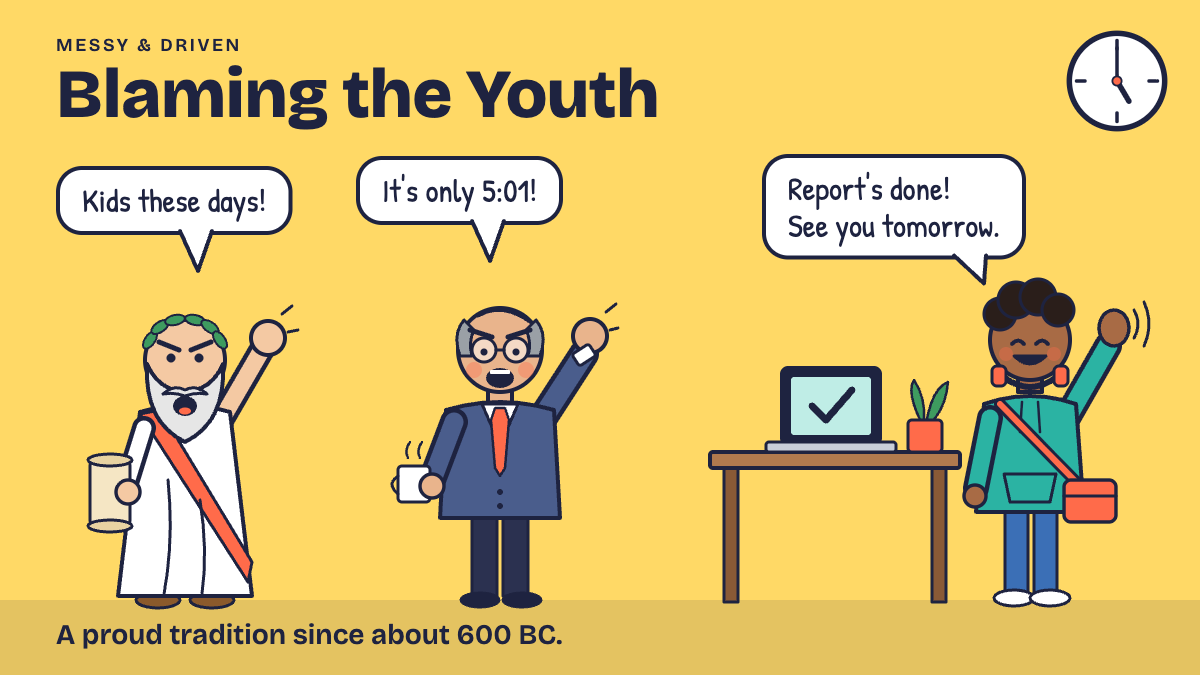
“Young people today only want to work 9 to 5.” You’ve heard it at a leadership offsite. Maybe you’ve said it on a Friday when the office emptied at 5:01.
I get it. When you built something on nights and weekends, other people’s boundaries can look like a lack of hunger.
So I went looking for the research. What I found surprised me. Then it made me look in the mirror.
How often even here at BLI – I have to rethink am I thinking of an employee based upon their age versus their value or ideas. Have I ever said ( or thought) “They might be too young?” “They wont want to do this?”
Generation explains very little
The best research says your birth year tells me almost nothing about how you’ll show up at work.
In 2012, a team led by David Costanza ran the first quantitative review of the evidence: 20 studies and nearly 20,000 people. They compared generations on job satisfaction, commitment, and intent to quit. The differences were small, and in many cases essentially zero (Costanza et al., 2012).
In 2020, the National Academies of Sciences went further. Their expert committee concluded that labels like “boomer” and “millennial” aren’t supported by research and can’t guide workforce decisions (National Academies, 2020).
What does explain the differences? Age, career stage, job experience, and how work itself has changed. In plain English: a 25-year-old acts like a 25-year-old. So did you.
What has actually shifted
Some things really have changed. They’re just not the things we complain about.
Deloitte’s 2026 survey reached 22,595 Gen Zs and millennials in 44 countries. In the UK sample, work-life balance was the top career goal, named by 20% of Gen Zs and 24% of millennials (Deloitte, 2026).
Here’s the part nobody quotes. 84% of UK Gen Zs and 73% of millennials want a leadership role at some point. Only 5% and 3% call it their primary goal. They want to lead. They just won’t make it their whole life.
And when Deloitte asked what holds them back from leadership worldwide, the answers were blunt:
- Stress and burnout: 50% of Gen Zs, 49% of millennials
- Too much responsibility: 50% and 48%
- Work-life balance worries: 41% and 46%
They’re not rejecting leadership. They’re rejecting the version of it they’ve watched burn people out.
The hours data does give the critics something. A UK study of labour force data found workers cut about 28 hours a year after the pandemic, and Gen Z’s hours fell the most (Hamilton, Jolles & Lordan, 2025). But every generation cut hours.
Then there’s money. Around 40% of UK Gen Zs and millennials say they live payslip to payslip. More than half say housing costs shape their career choices. That’s not a generation that’s coasting. That’s a generation doing math.
The 9-to-5 myth, flipped
Here’s the irony. Young workers aren’t clinging to 9 to 5. Many of them can’t stand it.
A Credit Karma study found 43% of Gen Zers have no interest in the classic career path, and most called the traditional 9-to-5 “soul-sucking” (Fortune, 2024). In an Upwork survey, 70% of Gen Z freelancers said they chose freelancing for one reason above all: control over their schedule (Inc., 2024).
So the complaint has it backwards. They don’t want 9 to 5. They want to decide when the work happens, and they want a clear line where it stops.
That’s not the same as wanting less of it. A boundary isn’t a lack of drive. Sometimes it’s what keeps the drive alive.
Why we keep blaming the youth
We’ve been doing this for a very long time. Psychologist John Protzko traces the same complaints about young people back at least 2,600 years (UC Santa Barbara, 2019). Even the label “Generation X” was first used in 1965 to describe teenagers who broke the rules, as Costanza’s review notes.
Protzko and Jonathan Schooler call it the “kids these days” effect. Across studies of 3,458 American adults, they found something uncomfortable. We judge young people as weakest in the very traits we’re strongest in (Protzko & Schooler, 2019).
People who respect authority think kids don’t. Big readers think kids don’t read. The cause is memory: we can’t recall what we were really like at 22, so we picture our current selves back then.
A follow-up study found it gets harsher as we age (Protzko & Schooler, 2022).
So if you’re messy and driven, guess what you’ll think young people lack? Drive.
What to do Monday morning
Stop managing a generation. Start managing the person in front of you.
- Ask, don’t assume. In your next one-on-one, ask: “When do you do your best work? What would make you stay?” Then listen.
- Measure output, not hours seen. If the work is excellent and on time, the clock is the wrong scoreboard.
- Redesign the leadership job before you offer it. Share the load, make decision rights clear, and let people see leaders who have a life.
- Say the money part out loud. Financial stress is shaping career choices. Make sure people know what support exists, from pay paths to your EAP.
- Check your lens before the hard conversation. Ask yourself: is this a performance problem, or a “not how I’d do it” problem?
Pull up a chair
Come into my living room and let’s get down to business. The next time you catch yourself blaming the youth, pause. Ask what you’re really seeing, and whose memory you’re comparing it to.
The young people on your team aren’t the problem to manage. They might be the ones showing us a better way to work.
Your turn: what’s one thing a younger colleague taught you about work? Hit reply. I read every one.
Messy and driven, Wendy
Sources
- Costanza et al. (2012), Generational Differences in Work-Related Attitudes: A Meta-analysis
- National Academies (2020), Are Generational Categories Meaningful Distinctions for Workforce Management?
- Deloitte (2026), Gen Z and Millennial Survey, UK press release
- Hamilton, Jolles & Lordan (2025), quiet quitting and hours worked across generations
- Fortune (2024), Credit Karma study on Gen Z and the 9-to-5
- Inc. (2024), Upwork survey on Gen Z freelancers
- Protzko & Schooler (2019), Kids these days: Why the youth of today seem lacking
- Protzko & Schooler (2022), Who Denigrates Today’s Youth?
- UC Santa Barbara (2019), Kids These Days


